You Can't Stop the World from Spinning: the book I'm writing
I'm writing a fourth book about protecting your time, creativity, and intention in the age of AI. Here's the introduction in full.
I've written three books about walking. Two are about the Camino, one is a pile of stories from twenty-odd years of buses that broke down and trails that went on longer than advertised. This next one is different, and it took me an embarrassingly long time to admit what it actually is.
It's called You Can't Stop the World from Spinning. There's travel in it, but it isn't a travel book. It's about the three things that go quietly missing when the world speeds up: your time, your creativity, and your intention.
I build with AI every day and I'm not going to stand here and tell you it's bad for you. It isn't. But everything is a click away now, answered in seconds by a machine that never sleeps, and it has never been easier to hand over the parts of a life that were the actual point. The thinking. The making. The deciding what's worth an afternoon. You can outsource all of it, and mostly nobody will stop you.
The other half of the book is older than any of that. Every time the ground moved under me, I did the same thing: I put on a pack and I left. Three years through India and Nepal before I was twenty-five. Caminos. Long walks on four continents, most of which I'd do again tomorrow. I told myself that was simply who I was, and some of it genuinely is. The rest was distance. I was putting kilometres between me and a person I didn't much want to be alone in a room with, and the arithmetic on that never works, because he walks at exactly your pace.
It took the end of my marriage and two freezing weeks in a Himalayan monastery to see it. It also took my father, who I have no relationship with and no reason to thank, saying it to me first in an email I've never forgiven him for.
Three words hold the whole thing together. Time, creativity, intention. You cannot get the hours back, and anyone selling you a system to reclaim your time is selling something that does not exist. What you can do, starting from wherever you happen to be standing right now, is guard the part of you that makes things and sees the world its own way, and spend what's left of the time on the life you're actually in.
Why I'm publishing the introduction before the book
The manuscript is done and in the final pass. Barring something going sideways, it should be on Amazon within a month.
The introduction has been finished for a while, and it's the piece that tells you whether the rest of it is for you, so I'd rather put it out now than sit on it until launch day. It's below in full, exactly as it stands in the manuscript. If you read it and feel something crack open, you're who I'm writing this for, and you can subscribe to be told the day it's live. If it doesn't land, that's genuinely fine, and there are a couple of hundred posts on this site about long walks and building things that might suit you better.
The introduction: you can't walk far enough
The computer sat in the back of a shop that also sold instant noodles, prayer flags, and single cigarettes from an open pack beside the till. One machine. A cracked monitor the colour of weak tea, and a keyboard worn smooth in the places where a thousand fingers had hunted for the same few letters. The connection came and went with the generator, which came and went with the will of a teenager asleep on a stool by the door. I had walked most of the day to reach the village, and I paid for twenty minutes because twenty minutes was all the patience I had left for the modern world.
I was somewhere in the high desert between Mustang and Ladakh, months into a walk that had no real end, only a direction, which was away. I was in my mid-thirties. My marriage had ended earlier that year, and I had done the thing I always did when the ground moved under me. I put on a pack and I left.
The inbox loaded one line at a time, most of it work I was ignoring on purpose. And then, near the top, a name I hadn't seen in years. My father.
I have no relationship with my father, and I haven't for most of my life. He is not a good man, and I have long since made my peace with saying that plainly. I couldn't tell you what the email was about. I don't remember the subject line, or what I had done at that age and from the other side of the planet to set him off this time. What I remember is one sentence, because I have carried it every day since:
No matter how many caminos you do, or how far you hike, you can't walk far enough to get away from yourself.
I read it twice. I was furious. Angry in that cold, quiet way that doesn't burn off in an hour, that just settles into your chest and stays. My hand was still on the mouse. Outside, a dog barked at nothing, and a woman called it back in.
I have never been able to forgive him for that email. The problem was, in a lot of ways, he was right.
The monastery was two days further on, a cluster of whitewashed buildings tucked into a fold of the mountain, so nearly the colour of the rock that you could walk past it if the light was wrong. I am not a Buddhist. I have never been able to sign up to the founding idea, the one that says life is suffering and the task is to suffer your way free of it. I lean the other way, toward the Taoists, who seem to me to have noticed something gentler: that the world is always trying to show you its balance, if you stop thrashing long enough to float. But a man who has been thrashing for twenty years does not get to be fussy about the lifeboat. I needed to sit still, and this was a place built for sitting still, so I stayed.
They gave me a cell with a wooden bed, a window the size of a paperback, and a cold that got into the joints and set up home. Before dawn the long horns would start, a sound you feel in the sternum a moment before you hear it, and the smell of juniper smoke and old butter would come in under the door. I sat when they sat. I understood almost none of it. And somewhere in the second week, doing nothing and understanding nothing, the strangest thing came over me, which was the full weight of how tired I was. Not sleepy. Tired in the way you only notice once you finally stop. I had been moving for so long, and calling it living, that I had never let myself feel the cost of the running. We are good at that, most of us. We stay busy enough to keep just ahead of that particular reckoning. The monastery didn't hand me peace. It only took away the movement, and without the movement there was nothing left to do but feel.
I should back up and tell you how I ended up in that cold room. I don't think my version of the story is all that unusual.
I left school with no idea what I wanted to do and no gift for standing still, so I went. Three years, mostly on foot and on buses that broke down as a matter of routine, through India and Nepal and up into mountains that made me feel the right size, which is to say small. I was happy in a way I have spent the rest of my life trying to describe and mostly failing. Somewhere in the middle of it, on a cheap laptop that had been banging around in my pack, I started to write code, and found that building something out of nothing scratched the same itch as arriving somewhere new. Two things I would need for the rest of my life, the hunger for experience as much of this world as possible and the hunger to create, and I found them both on the road before I was twenty-five.
Then I did the thing you are supposed to do. I came home. I turned the code into a career. I fell in love, properly and completely, and had a daughter who is still the best thing I have ever been part of. From the outside it was a good life, and I want to be honest that from the inside it was often a good life too. But I hung up my backpack. The part of me that had to see everything, that had been the truest thing about me since I was a boy, I folded up and put in a cupboard and told myself I had grown out of it. And I learned to manage the hunger the way most people do. I waited.
I told myself I only had to hold on until things settled. Hold on until the next promotion, until the mortgage was smaller and the diary was clearer and it was finally, responsibly, my turn. Waiting became a way to live. A lot of us live this way without ever noticing we agreed to it. We treat our real life as something that starts later, once the conditions are right, and we get very good at holding on. The trouble is that the conditions are never quite right, and the part of yourself you fold away and put in the cupboard does not sit there quietly. It waits too, and it does not wait kindly.
A hungry life does not sit quietly when you compromise it. It goes somewhere. Mine went inward and thickened into something heavier, the slow grey weather that has a clinical name I did not want to use at the time. Depression is insidious, creeping up on you, in my case, because I wasn't being genuine to who I was. By the time my marriage ended, I had spent the last decade being a smaller, quieter, safer version of myself and calling it growing up.
So I picked up the pack again. This time I told myself it was different, that I was walking toward something rather than away. My father, damn him, had put his finger on the one truth I had spent my whole life avoiding, and from both directions at once. You cannot walk far enough to get away from yourself. You also cannot sit still enough, in a good job in a warm house, to make the truest part of yourself disappear. I had tried both. What I had never tried was the only thing that works: staying inside one life long enough to actually meet the person I had spent so long fleeing and denying, and to stop waiting for permission to be him.
This book is what I learned. Not on that one walk, but across all of it. The three years and the twenty that came after. The mountains and the marriage and the long, slow education of getting it wrong first.
Most of it comes back to time. And the unfashionable truth about time is that you cannot reclaim it. The shelves are full of people promising to give you your time back, and they are selling something that does not exist. The hours you spent waiting are gone, and no book, this one included, will return them. What you can do, starting from wherever you happen to be standing, is spend the time that is left with intention, guard the part of you that makes things and sees the world its own way, and refuse to hand your one life over to autopilot. Time, creativity, intention. That is the whole book, honestly. Everything else is stories about how I came to learn it.
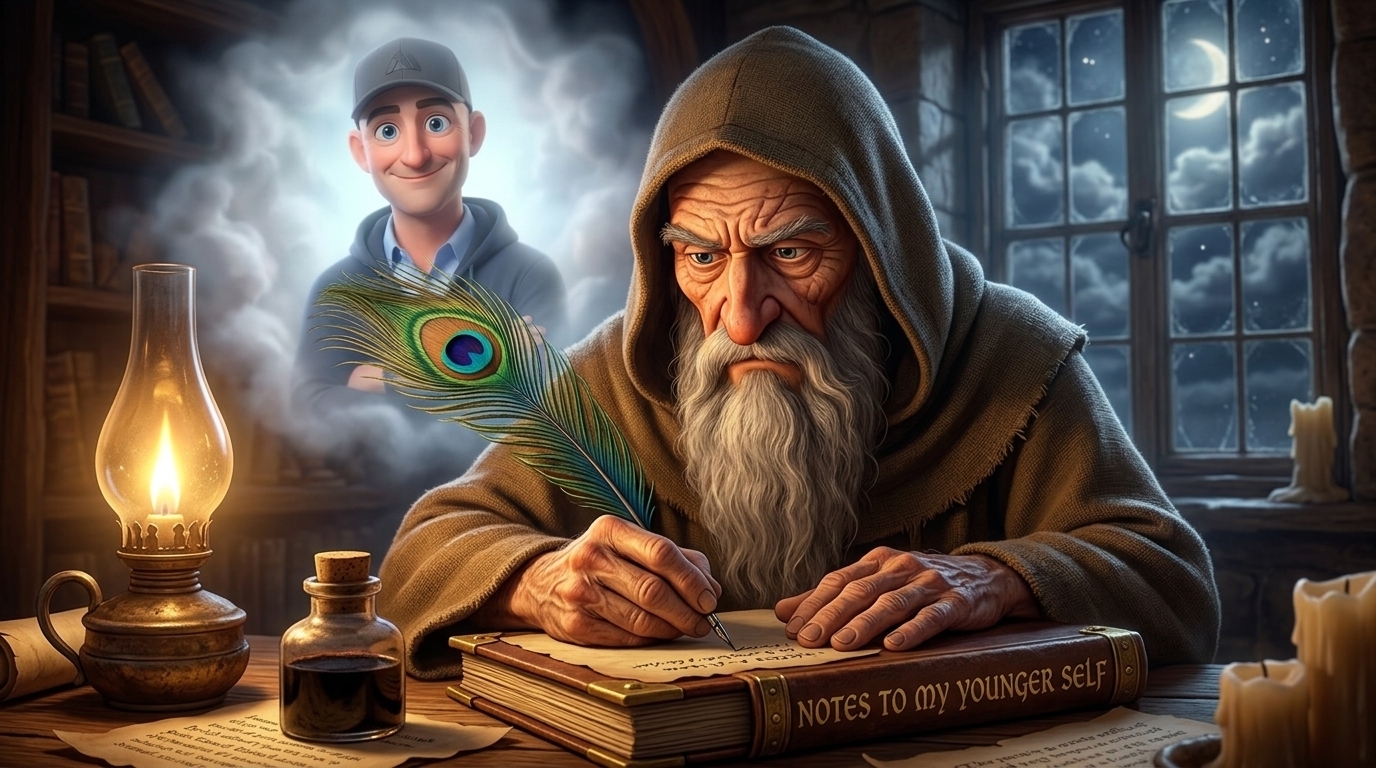
What if you could go back and leave a note for your younger self? Warn them off the mistakes you can already see coming. Tell them what actually matters, and what only feels like it does. Show them the life they keep putting off until the conditions are finally right. You cannot, of course. You cannot stop the world from spinning, and time only runs one way. But if I could go back, these are the lessons I learned across decades on the road that I would most want my younger self to know. He can't hear me, obviously. But you can, and my suspicion is that some of what I want to say to him you have been needing to hear for a while. Where I use my own life in these pages, it is only ever to show you where a lesson came from, so that you might trust it enough to try it. The lessons are yours now. What you do with them is the only part that was ever going to count.
There is one thing I have never stopped chasing. When I was twenty, on a monastery courtyard in Dharamsala, my mind went quiet for the first time I could remember. Not sleepy. Quiet. There was a weightlessness to it, a sense of wanting nothing and missing nothing, standing in the cold with the sun not yet over the wall. It lasted less than a minute. I have spent the years since learning that it never arrives when I reach for it, and dissolves the moment I try to hold it, and turns up unannounced only when I have finally stopped waiting for it.
My father was right. You cannot walk far enough to get away from yourself. So stop trying. Turn around and walk the other way, toward the person you already are. Accept him, the restlessness and the quiet and all of it, and then do something with him, on purpose. Spend the time you have left as though it belongs to you, because it does, and give it to the few things that actually fit the shape of you. That is where the weightlessness lives. It is closer than eight hundred kilometres. It is closer than the next promotion. It is about fifteen minutes past the moment you stop holding on.
Subscribe to find out when the book launches
That's the introduction. The rest is written, and it should be on Amazon within a month.
There's exactly one way to hear the moment it's live, and it's the subscribe box just below this post. Put your email in it. The day You Can't Stop the World from Spinning is up and you can actually buy it, that list is where I'll say so, and the people on it will know before anyone else does.
It's a short list. I send to it when I have something real to send, which is not often. No launch sequence, no countdown timer, no daily emails building anticipation. Just a note saying the thing exists and here's where to get it, and the odd chapter along the way if I think it's worth your time.
If the introduction hit something in you, I'd like to hear about it too. Subscribe and hit reply on the first email that lands. I read all of them. I'm writing this for the people who recognized themselves in the running, so it helps to know who you are.
Subscribe
New posts on AI, developer relations, photography, and the odd long walk, straight to your inbox. No spam.